A Warm Bath Before Bed: Why the Ritual Matters

There is something naturally different about a bath at the end of the day.
The lights are lower. The house may finally be quieter. Your phone can be set aside. Warm water creates a physical separation between everything you have been doing and whatever comes next.
That is what makes a bedtime bath valuable: not as a guarantee that you will fall asleep faster, but as a repeatable signal that the active part of the day is ending.
The National Sleep Foundation recommends establishing a relaxing bedtime routine and specifically lists taking a warm bath as one activity that can be included. Research into warm baths and showers before bedtime also suggests that the combination of warmth and timing may support the body's normal transition toward sleep.
In other words, the best bedtime bath is not about trying to force yourself to sleep.
It is about creating the conditions for a calmer evening.
Here is how to turn a simple soak into a nighttime ritual you actually look forward to.
1. Think of Your Bath as the Beginning of Bedtime
Many evening routines start too late.
We stay busy, scroll through our phones, answer one more email, finish one more chore—and then expect our minds to switch instantly into sleep mode.
A bath can create a useful transition point.
Instead of thinking of bedtime as the moment you get into bed, consider beginning your nighttime routine earlier. Your bath becomes the first step in slowing things down.
That might mean:
- Dimming the lights before you run the water.
- Putting your phone somewhere out of reach.
- Changing into comfortable clothes afterward.
- Keeping the rest of the evening relatively quiet.
- Repeating the same general routine from night to night.
The goal is consistency rather than complexity.
Over time, those familiar cues can help make the evening feel different from the rest of the day.
2. Choose Warm Water, Not the Hottest Water Possible
It is tempting to assume that hotter water equals a more relaxing bath.
It does not have to.
Choose water that feels comfortably warm rather than excessively hot. You should be able to settle into the tub without immediately feeling overheated.
There is also an interesting connection between bathing and body temperature.
Our core body temperature naturally changes as bedtime approaches. Research on passive body heating has examined whether taking a warm bath or shower before bed can work with that natural process.
A 2019 systematic review and meta-analysis published in Sleep Medicine Reviews found that warm bathing or showering before bedtime was associated with improvements in several sleep measures. The researchers found particularly useful results when warm-water bathing occurred roughly one to two hours before bedtime.
That does not mean you need to watch the clock precisely every night—or that a warm bath is a treatment for insomnia.
It simply gives you a practical starting point.
If you normally go to bed around 10:30 p.m., for example, try beginning your bath sometime around 8:30 to 9:30 and see how that timing fits your routine.
3. Let Aroma Mark the Change in Mood
Scent can help make an ordinary bath feel intentional.
The important thing is not finding a supposedly "perfect" sleep scent. It is choosing an aroma that you personally associate with slowing down.
For an evening bath, Relax Spa & Bath offers several different directions.
Lavender Palmarosa is a natural choice when you want a softer, floral atmosphere.
Rather than treating lavender as a sleep treatment, think of it as part of the sensory environment you are creating: warm water, lower lighting, quiet surroundings, and a familiar aroma that fits the mood of the evening.
Some nights call for something warmer and more comforting.
Warm French Vanilla can make an evening bath feel cozy and indulgent—especially during colder weather or after a long day when you want your bath to feel less energizing and more like a retreat.
When the day has felt particularly busy, De-Stress can become part of a deliberate transition away from work, errands, screens, and responsibilities.
The name describes the experience you are trying to create, not a medical outcome: a quieter environment and a few uninterrupted minutes to decompress.
The best aroma is ultimately the one that makes you think:
The day is done.
4. Give Yourself Enough Time to Actually Slow Down
A relaxing bath should not feel like another appointment you are rushing through.
You do not need an hour, though.
Around 15 to 20 minutes can provide enough time to settle into the warmth, enjoy the aroma, and mentally transition away from the day.
During your soak, keep things simple.
Try:
- Five slow, comfortable breaths.
- Relaxing your shoulders.
- Letting your hands rest instead of holding your phone.
- Listening to quiet music.
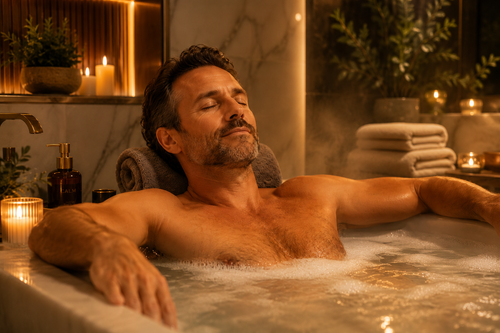
- Closing your eyes for a few minutes.
- Noticing the warmth and aroma of the water.
- Allowing yourself to do absolutely nothing.
You are not trying to perform relaxation correctly.
You are simply giving yourself fewer things to respond to.
That difference matters.
5. Protect the Calm After You Get Out
One of the easiest ways to undo a peaceful bath is to get out and immediately return to bright lights, work, social media, or stressful television.
Instead, think of the bath as the beginning of a soft landing into the rest of your evening.
After your soak:
- Dry off and put on comfortable clothes.
- Keep the lighting lower if possible.
- Drink some water.
- Read, stretch gently, journal, or listen to quiet music.
- Keep unnecessary screens to a minimum.
- Head to bed at your usual time.
The National Sleep Foundation emphasizes the value of a regular sleep schedule and a relaxing bedtime routine.
Your bath can simply become one enjoyable piece of that larger pattern.
A Simple Bedtime Bath Ritual to Try Tonight
You do not need to redesign your entire evening.
Start with this:
One to two hours before bed: Begin winding down.
Step 1: Lower the lights and put your phone away.
Step 2: Run a comfortably warm bath.
Step 3: Choose a Relax Spa & Bath aroma that matches the mood you want—Lavender Palmarosa for soft floral calm, Warm French Vanilla for cozy comfort, or De-Stress for an end-of-day reset.
Step 4: Allow the bath crystals to dissolve.
Step 5: Soak for about 15 to 20 minutes.
Step 6: Keep the rest of the evening quiet and low-stimulation.
Step 7: Go to bed around your usual time.
Then repeat it another night.
That repetition is what turns a bath into a ritual.
The Goal Is Not to Force Sleep
Sleep can become harder when we turn it into something we have to accomplish.
A bedtime bath offers a different approach.
You are not getting into the tub because you must fall asleep afterward. You are creating a transition between the demands of the day and the quieter hours of the night.
Warm water.
A scent you enjoy.
Lower lights.
Fewer distractions.
A little time to yourself.
Sometimes the most useful evening routine is simply one that tells you:
You are finished for today.
Make Your Evening Soak a Ritual
Create a bedtime bath you look forward to with Relax Spa & Bath aromatherapy crystals.
Choose Lavender Palmarosa for a soft floral experience, Warm French Vanilla for comforting warmth, or De-Stress when you want your bath to mark the transition from a busy day to a quieter evening.
Your bath does not need to guarantee a perfect night's sleep to be worthwhile.
Sometimes, creating a better ending to the day is enough.